

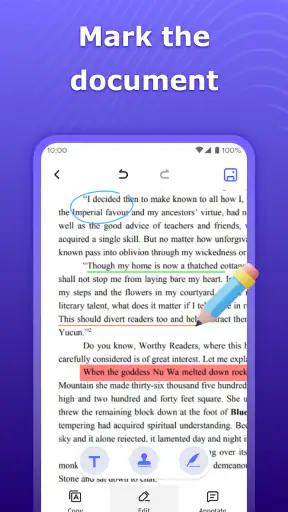
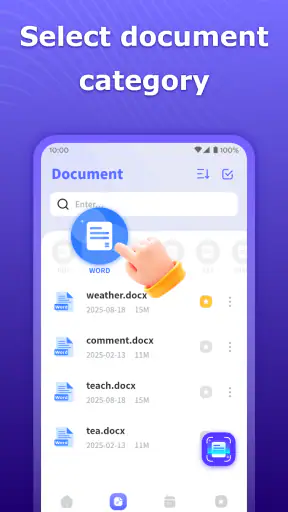
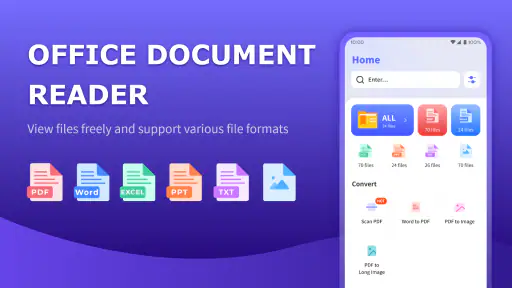
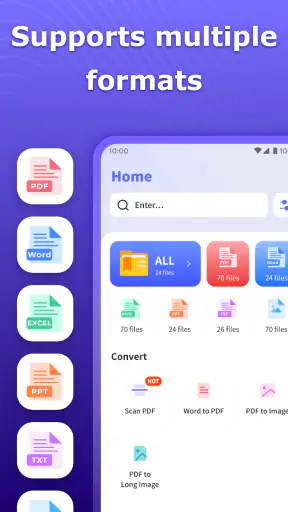
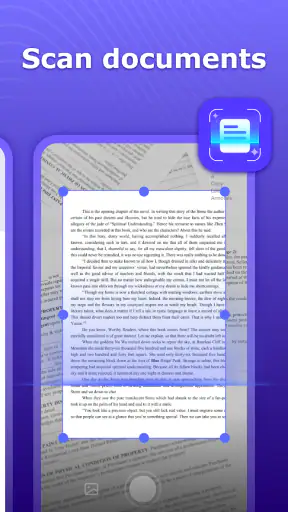
When I first opened All Document Guide, I approached it as a lightweight productivity app rather than a full office suite. That distinction matters. Its purpose is to help with basic document processing, so the best experience comes from treating it as a practical starting point when you need guidance around everyday document tasks, not as a replacement for a complete desktop editor.
The app is free, aimed at everyone, and developed by XuanLong Studio. It belongs in the productivity category and has attracted more than a million installs, which tells me that its simple document-focused idea has reached a broad audience. The current release is version 1.1.0, and it works on Android devices running version 6.0 or later. Those requirements make it accessible on many older phones as well as newer models.
My overall impression is that All Document Guide is most useful for people who want a straightforward document companion without immediately committing to a larger, more complicated office application. It can be a sensible first step for students, casual users, and anyone who regularly receives documents but does not yet have a comfortable routine for handling them. At the same time, users expecting advanced editing, deep collaboration, or desktop-level file management should set their expectations carefully.
What to expect before you begin
The short description, “All Document Guide,” gives a better clue to the app’s character than a promise of a complete professional workspace. I would think of it as a guide-oriented tool for basic document processing. That means the value is likely to appear in small, practical moments: understanding what to do with a document, finding a suitable way to handle it, or getting through a simple task without opening several unrelated apps.
This positioning is especially helpful for first-time users. Many document apps present a crowded screen full of editing controls, file formats, cloud services, and sharing options. That can be useful for experienced users, but it can also make a basic task feel harder than it should. All Document Guide is better suited to someone who wants a less intimidating entry point.
I would not install it expecting the same depth as a dedicated word processor, spreadsheet editor, or document scanner. Those tools are designed around specialized workflows. A guide-focused productivity app has a different role: it can help you approach document work more comfortably, but it should not automatically be treated as the only tool for every file-related job.
The public response is reasonably positive rather than exceptional, with an average rating of 3.8 from around 4.3 thousand ratings. I read that as a useful signal to keep expectations balanced. The app clearly works well enough for many people to try and continue using, but the rating also suggests that the experience may not satisfy every type of document user equally.
One practical way to decide whether it belongs on your phone is to start with your most common document problem. If your need is “I often receive documents and want a simple way to understand what to do next,” the app’s concept makes sense. If your need is “I must create complex reports with precise formatting,” a dedicated office application will probably be a better fit from the beginning.
Who will get the most from it
I see the strongest audience as people who use documents occasionally rather than continuously. A student checking material for an assignment, a family member opening an attachment, or a small-business owner dealing with routine paperwork may appreciate a simpler environment. These users often need confidence and direction more than a long list of advanced controls.
It can also suit someone moving from a computer to a phone-based workflow. Mobile document work often becomes frustrating when every task requires a different app. A guide that keeps the basic process understandable can reduce that friction, particularly when the user is learning how to organize document-related tasks on a phone.
On the other hand, I would skip it as a primary solution if your daily work depends on sophisticated formatting, tracked revisions, complex tables, presentation design, or team editing. In those situations, established office suites usually offer stronger compatibility and a more complete set of controls. All Document Guide may still be useful as an introductory companion, but it should not be expected to replace those specialized tools.
Getting through the first setup
After installation, I recommend beginning with a very small goal instead of trying to understand every part of the app at once. Choose one document-related task you regularly avoid. For example, you might decide that your first session is only about learning how to approach a document you have received, rather than trying to build a complete filing system.
This approach is more effective because productivity apps can feel vague when viewed as a collection of menus. A concrete task gives each screen a purpose. If you open All Document Guide while holding a real document in mind, you can judge quickly whether its guidance is clear and whether the workflow feels comfortable on your phone.
I also suggest keeping your first test document non-sensitive. Use a harmless sample, an old document you no longer need, or a file that contains no private information. That lets you explore the app without worrying about making a mistake with an important contract, identity document, school submission, or financial record.
Before relying on the app for important work, check how its instructions fit your own habits. A guide can explain a process clearly, but the final result still depends on where your files are stored, which other apps you use, and how you share or preserve the finished document. The most useful setup is therefore not just installing the app; it is deciding where it fits in your existing routine.
A simple preparation method is to separate documents into three mental groups: items you are still reviewing, items that need an action, and items you are keeping for reference. Even if All Document Guide does not replace a full file manager, this distinction makes its guidance easier to apply. It also prevents the common mistake of treating every document as if it requires the same next step.
Your first meaningful success
For a first successful session, I would choose one document and aim to finish a complete, modest action with it. That could mean understanding its purpose, following the appropriate basic processing path, or reaching the point where you know which separate tool should handle the next stage. Success here is not about performing a complicated edit; it is about leaving the app with less uncertainty than you had when you opened it.
This is an important distinction for beginners. A document guide does not need to do everything itself to be useful. If it helps you identify the right kind of task and avoid opening the wrong tool, it has already saved time. In my view, that is where the app can feel more approachable than a large office suite, especially for someone who is still learning the difference between viewing, editing, converting, and organizing a document.
Try to repeat the same small workflow with a second file only after the first one feels clear. Repetition reveals whether the app is genuinely helping or whether the first result was simply easy because the document happened to be uncomplicated. It also helps you notice which parts of the process belong inside the app and which parts are better handled elsewhere.
One non-obvious tip is to use the app as a decision-making checkpoint. Instead of opening it only when you are stuck, open it at the start of a document task and ask yourself what outcome you need. Do you need to read something, change its contents, preserve its layout, send it to someone, or simply keep it organized? That question can prevent wasted effort and makes the app’s guide-like role more valuable.
Where first-time users may hesitate
The biggest possible source of confusion is the difference between guidance and full document manipulation. The name may lead some people to expect an all-in-one editor, but the app’s stated focus is basic document processing. If you are looking for a complete replacement for a word processor, you may feel that the experience stops short of your expectations.
Another point to keep in mind is that document work is rarely a single action. You may begin by reading a file, then need to edit it, export it, send it, and store a safe copy. A guide can help with the overall direction, but it does not remove the need to understand the rest of your phone-based workflow. I found it more useful when treated as one part of the process rather than the entire process.
Compatibility is another reason to test gradually. Documents can contain unusual layouts, embedded elements, or formatting that behaves differently between mobile apps. I would never assume that a file will look identical everywhere simply because it opens successfully. For an important document, compare the result with the original and keep a separate copy before making changes.
That caution is not a criticism unique to this app; it is a basic reality of mobile document handling. Still, it affects how I would recommend using All Document Guide. It is a comfortable place to learn and handle ordinary tasks, but high-stakes documents deserve a more deliberate workflow with backups and a specialized application when formatting matters.
The age rating of Everyone makes the app approachable for a broad audience, including households where several people share a need for simple document help. Even so, an everyone-friendly rating does not mean every document is suitable for casual experimentation. Users should still apply common sense with private files, especially when a document contains personal or confidential material.
Practical everyday scenarios
Imagine receiving a document attachment while you are away from your computer. You know you need to deal with it, but you are unsure whether the immediate task is simply reading it, preparing a response, or moving it into a more permanent record. This is the kind of moment where a basic guide can be more useful than a powerful editor filled with controls you do not need.
Another realistic example is a student who has several document types mixed together on a phone. Rather than opening each file randomly, the student can use All Document Guide to build a more deliberate habit: identify the purpose of the file, decide what action is required, and then use the appropriate tool for the final work. The benefit is not just the individual document; it is learning a repeatable process.
For a small business owner, the app may be helpful during the early stage of handling routine paperwork. It can act as a reminder to clarify the task before editing or forwarding anything. That is a modest benefit, but it can reduce avoidable mistakes caused by rushing through a document simply because it arrived on a mobile screen.
A third useful scenario is helping a less confident family member. Instead of explaining a large office suite with many unrelated features, you can begin with the narrower purpose of All Document Guide. The conversation becomes easier when the goal is “let’s understand what to do with this document” rather than “learn an entire productivity platform.”
My most useful workflow tip is to write down the intended outcome in a few words before starting. “Read and save,” “make a correction,” or “send for review” is enough. This small step exposes a trade-off: the app can simplify the beginning of document work, but it cannot decide the right outcome for you. Clear intent makes its guidance much more practical.
How it compares with familiar alternatives
Compared with a full office suite, All Document Guide appears less ambitious and potentially easier to approach. Office suites are stronger when you need extensive editing, file creation, formatting control, and collaboration. Their weakness for beginners is the amount of complexity they bring to a simple task. I would choose the office suite when the document itself is the central project, and All Document Guide when I first need help understanding the workflow.
Compared with a file manager, the app occupies a different place. A file manager is usually best for locating, renaming, moving, and organizing files. All Document Guide is more relevant when you are unsure how to process a document once you have found it. Using both can make sense: one handles location and storage, while the other helps you think through the document task.
Compared with a dedicated scanner or converter, it is also likely to be less specialized. Those apps are preferable when the main goal is capturing paper, changing a file format, or preserving a particular layout. The advantage of a broader guide is that it can help you avoid choosing a specialized tool too early, but the trade-off is that it may not deliver the same depth in one narrow area.
This comparison explains why the app’s rating feels understandable to me. People who want a simple document starting point may find it useful, while users who install it expecting a complete office replacement may judge it more harshly. The right choice depends less on the number of features and more on whether your problem is uncertainty or advanced production.
What to do after the first session
Once you have completed one small task, the next step is to decide whether the app deserves a regular place in your routine. Try it with a few different ordinary documents, not just one easy example. Notice whether its guidance remains clear when the document’s purpose changes and whether you still need to switch between several other apps for the final result.
If it consistently helps you choose the next action, keep it as a front door for document work. You can open it first, clarify the task, and then move to a specialist tool when necessary. This is probably the most realistic long-term role for it: a simple starting point that supports better decisions rather than a universal replacement for every document application.
If you find yourself needing advanced controls almost immediately, do not force the fit. A dedicated editor, scanner, converter, or file manager may serve you better. All Document Guide is free, so trying it costs nothing financially, but your time still matters. The best productivity app is the one that reduces steps for your actual work, not the one that sounds broadest.
It is also worth remembering that the app is relatively new, having been released on November 4, 2025. That gives its current version, 1.1.0, room to develop further, but it also makes it sensible to judge the present experience rather than rely on hopes about future additions. I would use it for ordinary tasks first and keep a backup method available for anything important.
My final recommendation is straightforward: install All Document Guide if you want a gentle, free introduction to basic document processing on an Android phone and you are comfortable using specialist apps when a task becomes demanding. I would recommend it to a friend who feels lost when documents arrive, especially someone who wants a clear starting routine rather than a crowded office suite.
I would not recommend making it your only document tool if your work depends on exact formatting, complex editing, or intensive collaboration. Its strength is the first step: helping you understand what you are trying to do and approach everyday document tasks with less hesitation. Used on those terms, it is a practical productivity companion from XuanLong Studio, with a broad audience and a reassuringly simple purpose.


